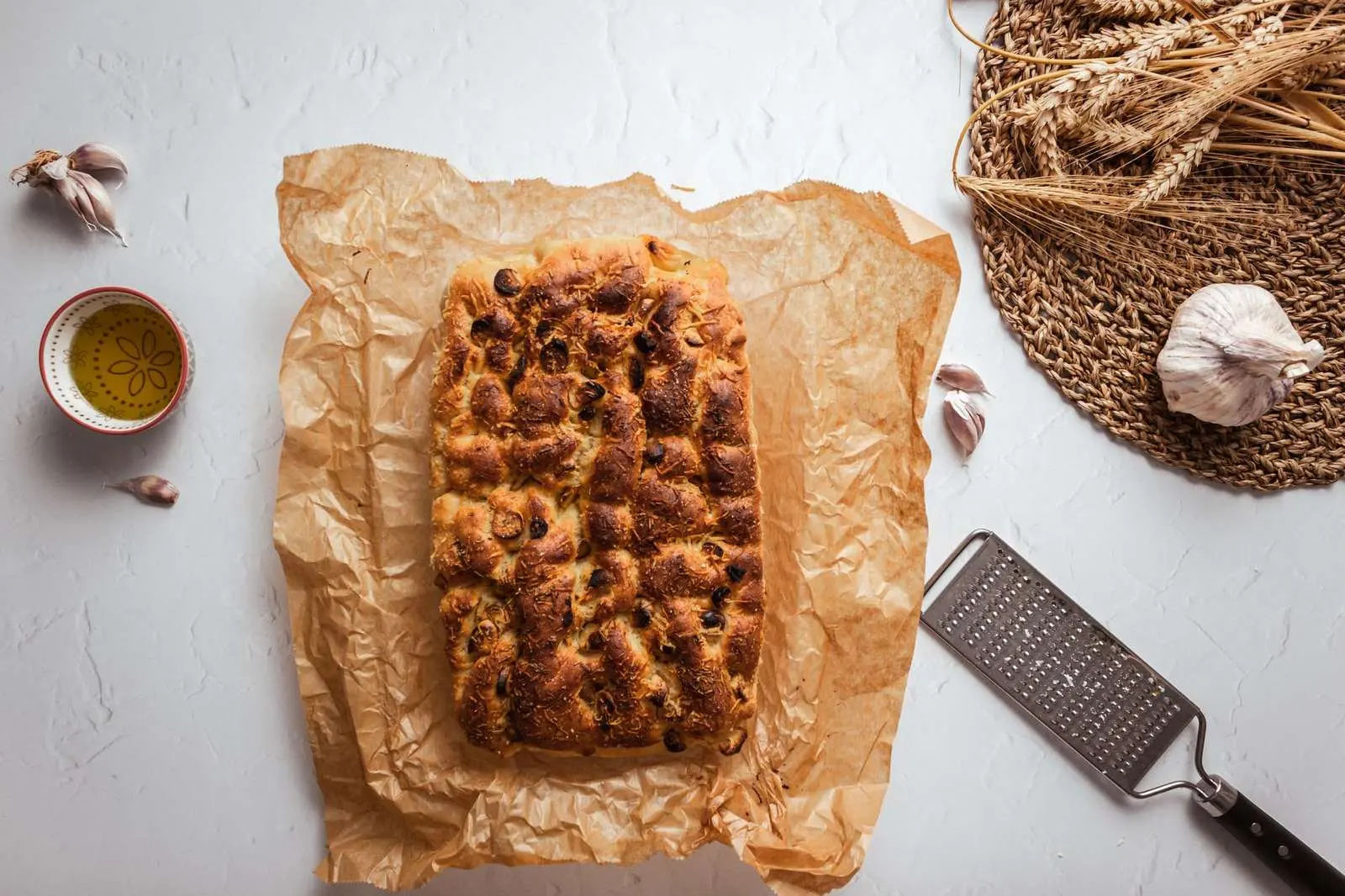
Worried your focaccia will come out dry and bready? This focaccia genovese recipe uses a salty brine, firm fingertip dimples and a hot oven for the Ligurian result: about 15 minutes at 450 degrees Fahrenheit.
This bread sits at the heart of regional italian food, and it rewards patience far more than skill.
| Item | Value |
|---|---|
| Flour for two 30×40 cm trays | 400 g type 00 plus 250 g Manitoba |
| Kneading time | 13-15 minutes |
| Bake time | 15 minutes |
| Modern home oven heat | around 450 degrees Fahrenheit |
| Traditional oven heat | around 550 degrees Fahrenheit |
| Storage | up to 1 day in a paper bag |
Figures come from GialloZafferano and Tasting Table. They can change, so check the source before you rely on them.
What makes focaccia genovese different
Focaccia genovese is Genoa’s everyday bread: soft inside, golden outside and generously soaked in olive oil. Visit Genoa says its history probably goes back to the period of the Republic of Genoa, when bread was the main food of the population. The same page notes that the recipe has stayed practically the same, with olives, onions, sage, rosemary and cheese added later as variations.
Two details define the classic: hand dimpling with three fingers, and a salty brine poured over the dimples together with oil. Tasting Table adds that older recipes fed the yeast with malt extract instead of sugar and baked at around 550 degrees Fahrenheit. Modern bakers use around 450 degrees Fahrenheit and get a lighter-colored, softer crust.
The version below follows the method of Ezio Rocchi as published by GialloZafferano. It is a long, hands-on bread, but nothing in it is difficult.
Ingredients for two trays
The quantities below make two trays of 30×40 cm, following the GialloZafferano recipe. Two flours give the dough its structure, and the oil is split between the pans, the surface and the brine step.
| Ingredient | Amount |
|---|---|
| Type 00 flour | 400 g |
| Manitoba flour | 250 g |
| Water, at room temperature | 335 g |
| Fine salt | 13 g |
| Malt | 10 g |
| Fresh brewer’s yeast | 18 g |
| Extra virgin olive oil, to grease the pans | 30 g |
| Extra virgin olive oil, for the surface | 30 g |
| Brine: water | 200 g |
| Brine: salt | 10 g |
Amounts come from GialloZafferano; recipes differ, so check the source before you scale them.
Choose your olive oil with care. Saveur warns that a bitter oil can ruin the entire batch, and Great Italian Chefs advises the best extra virgin olive oil you can afford.
If you cannot find malt, GialloZafferano says you can use the same amount of brown sugar.
Step-by-step method
Mix and knead the dough
Put both flours in a bowl, make a slight well and pour in almost all the water. Stir in the malt and salt, then the rest of the water. Once the salt is in, add the crumbled brewer’s yeast, as GialloZafferano directs.
Tip the dough onto the worktop and knead it energetically. When the gluten mesh begins to form and the dough turns almost elastic, pour on the oil. The same recipe expects the whole job to take 13-15 minutes before the dough is smooth and homogeneous (source).
Divide, fold and rest
Cut the dough into two pieces of 500 g, press each into a rectangle and fold it onto itself like a letter. Roll each piece up so the closure sits against the lightly floured worktop. Cover with a cloth and leave the dough to rest for about 30 minutes, following GialloZafferano.
Shape the dough in the tray
Grease the first pan, leaving the corners dry. Flatten the dough with only the index, middle and ring fingers, roll it out, then lift it onto the tray so it covers 70-80% of the tray. Cover it and let it rest for 20-30 minutes while you repeat with the second piece (GialloZafferano).
Next, dust with flour and press the dough toward the edges, starting from the perimeter to form a small rim. The dough must stick to the pan, otherwise the brine ends up underneath it. Smooth the top, cover again and let it rest for an hour, as that recipe explains.
Dimple and add the brine
Stir 10 g of salt into 200 g of water until it dissolves. Uncover the dough, dust it lightly with flour and make the dimples with the same three fingers, pressing firmly toward the edges with your fingers slightly angled, not perpendicular. Leave about 1 cm between holes, according to GialloZafferano.
Pour 30 g of oil and 90 g of brine into the center of each focaccia and spread it gently to fill every hole. It will look like too much liquid, yet Saveur reassures you that the brine should fill all of the dimples. Then let the trays rise uncovered for 40-45 minutes (GialloZafferano).
Bake until golden
Bake in a static oven preheated to 450° F for 15 minutes. If your oven is very powerful, GialloZafferano recommends adjusting the bake time rather than the temperature. Take the trays out when the surface is golden, cool them for a few minutes, then cut and serve.
How hot and how long should you bake it?
Published recipes disagree on the details, so treat the numbers as a starting range:
- GialloZafferano bakes for 15 minutes at 450° F.
- Visit Genoa bakes for about 30 minutes at 200 – 230 ºC.
- Saveur bakes for 18-22 minutes, rotating the trays between the top and bottom racks halfway through.
Oven strength, tray material and dough thickness explain most of that spread. Judge by color: Saveur wants golden tops while the dimples stay light beige, then brushes the focaccia liberally with olive oil as soon as it leaves the oven (Saveur).
Heat also shapes the crust. Tasting Table links the hotter traditional bakes to a darker, crispier crust, and the gentler modern ones to a softer crust.
Slower methods and flavor variations
The method above takes an afternoon, but other trusted recipes spread the work over more time to build flavor:
- Saveur starts a sponge the night before and lets it sit for 12-14 hours.
- Wikibooks refrigerates the dough overnight in an oiled bowl.
- Visit Genoa describes a simpler rustic route with two rests of 2 hours each.
Once the plain loaf is mastered, add a topping. Great Italian Chefs says olives or finely sliced white onion are often sprinkled over the dough just before the second resting time. Rosemary is another classic, and the same recipe describes the bread as doused in olive oil and scattered with it.
Serving and storing your focaccia
There is a local trick to eating it. According to Ezio Rocchi, quoted by Saveur, the Genovese eat their slice upside down so the tongue meets the salty upper surface and the flavor is more intense.
Visit Genoa calls it great for breakfast, extraordinary for an informal lunch and a quick snack for an aperitif with local wines. Given that range, a tray rarely lasts long.
For leftovers, GialloZafferano says focaccia keeps in a paper bag for up to 1 day. You can freeze it once baked, but the same page does not recommend freezing the raw dough.
If you are planning a wider Italian menu, the saltimbocca alla romana recipe and the arancini recipe are good places to go next.
Frequently asked questions
Which yeast should you use?
Show answer
Follow the type your chosen recipe names. GialloZafferano and Visit Genoa use brewer’s yeast, while Tasting Table reports that many modern recipes moved to instant yeast because it is quicker to prepare. Wikibooks also calls for instant yeast, so check the Tasting Table discussion if you are unsure.
How do you know the dough is ready to dimple?
Show answer
Press a finger firmly into it. Saveur says that if the dough springs back, it is not ready, so re-cover it and let it proof until the indentation stays.
Does authentic focaccia need toppings?
Show answer
No. Wikibooks sums up the Genoa style as simply sprinkling with salt. Tasting Table adds that focaccia alla genovese stays faithful to its minimalist origins even though modern recipes may include vegetables.
Can you mix the dough without a machine?
Show answer
Yes. Wikibooks suggests dipping your hand or a spoon in cold water and working the dough vigorously while rotating the bowl, much like a dough hook does. See the full technique on the Wikibooks page.